Every Instacart shopper needs a reliable Instacart tax calculator before the April deadline arrives. Shopping for Instacart feels like flexible, easy money — until you realize the IRS expects a cut and nobody told you how much to save. Unlike a regular job, Instacart does not take out any tax from your weekly earnings. Because of this, the full tax bill lands on you at the end of the year, often as a complete surprise.
Are Instacart Shoppers Self-Employed?
Yes — Instacart classifies all its shoppers as independent contractors, not employees. This single fact changes everything about how your taxes work. As a self-employed shopper, you are responsible for paying self-employment tax, federal income tax, and state income tax entirely on your own. Nobody takes it out of your paycheck automatically.
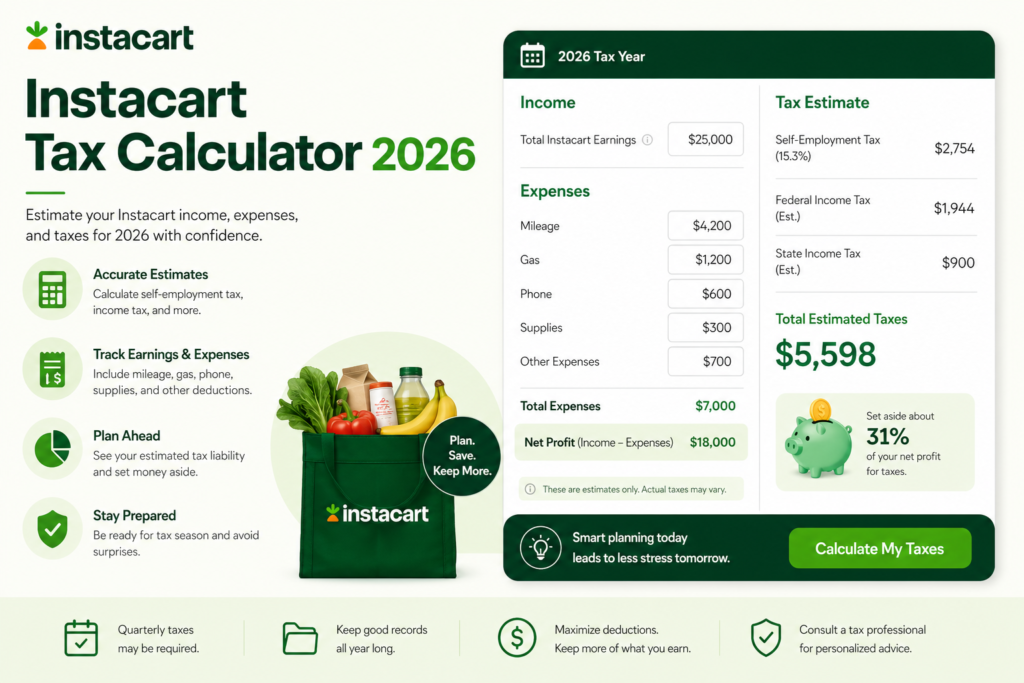
Moreover, as a self-employed person you pay both sides of Social Security and Medicare tax. A regular employee splits this cost with their employer — 7.65% each. As an Instacart shopper, you pay the full 15.3% yourself. That is why so many shoppers end up with a bigger tax bill than they expected.
How the Instacart Tax Calculator Works
Our free Instacart tax calculator on the homepage is simple to use. First, enter your total Instacart earnings for the year — this is the gross amount before any expenses. Next, add your business miles driven at the 2026 IRS rate of 72.5¢ per mile through June 30 and 76¢ after. After that, include other work expenses such as insulated bags, your phone bill, or any supplies you buy for shopping trips. Finally, select your state and filing status.
From those inputs, the calculator works out your net profit, your self-employment tax, your federal and state income tax, and breaks everything into four quarterly payment amounts. Head to our free gig worker tax calculator to run your numbers right now.
Top Tax Deductions for Instacart Shoppers
Tracking deductions is one of the most powerful things an Instacart shopper can do to lower their tax bill. Here are the main ones to know about.
Mileage is the biggest deduction for most shoppers. At 72.5¢ per mile through June 30 and 76¢ after in 2026, a shopper driving 8,000 business miles per year saves $5,600 in taxable income. Your business miles include the drive from your home to the store, between stores, and from the store to the customer. Always track from the moment you accept a batch.
Insulated grocery bags are fully deductible since they are used only for work. Phone expenses are also deductible — if you use your phone primarily for the Instacart app, a portion of your monthly bill counts as a business expense. Parking fees and tolls on work trips are deductible too. For a full list of allowable deductions, visit the IRS Self-Employed Tax Center.
Quarterly Tax Deadlines for Instacart Shoppers in 2026
As a self-employed Instacart shopper, the IRS expects you to pay estimated taxes four times a year. This applies to anyone who expects to owe $1,000 or more for the full year — which covers most active shoppers. Missing a quarterly deadline leads to an underpayment penalty on top of the tax you already owe.
The 2026 quarterly due dates are as follows. Q1 covers January through March and is due April 15. Q2 covers April and May and is due June 16. Q3 covers June through August and is due September 15. Q4 covers September through December and is due January 15, 2027. Our Instacart tax calculator splits your total estimated bill into four equal amounts automatically.
How Much Should Instacart Shoppers Set Aside?
A good starting point for most Instacart shoppers is to set aside 25–30% of every payment. However, your exact rate depends on your state, filing status, and how many deductions you track. A shopper in a no-income-tax state like Texas or Florida with strong mileage records might manage with 20–22%. On the other hand, a shopper in California or New York with high earnings could owe closer to 32–35%.
The best approach is to run your numbers through an Instacart tax calculator at least once per quarter. That way you can adjust your savings rate as your income goes up or down throughout the year.
Does Instacart Send a 1099?
Yes — if you earned $600 or more from Instacart in a calendar year, you will receive a 1099-NEC form by January 31 of the following year. This form shows your gross earnings and is used to report your income on Schedule C when you file your taxes. Keep in mind that Instacart reports your total earnings before any expenses — so it is up to you to track and deduct your costs.
If you earned less than $600, Instacart may not send a form. However, you are still legally required to report all income to the IRS regardless of whether you receive a 1099.
Get Your Free Instacart Tax Estimate Now
Do not wait until March to find out what you owe. Head to our free gig worker tax calculator right now, enter your Instacart earnings, miles, and expenses, and get a full breakdown in under 60 seconds. You will see your self-employment tax, federal and state tax, total bill, and exact quarterly payment amounts — all in one place.
If you also work for DoorDash or Uber, check out our DoorDash Tax Calculator guide and our Uber Driver Tax Calculator guide for platform-specific breakdowns. For questions about the site, visit our About Us page.
Instacart Shopper Tax Questions — Answered
Q: Do you have to pay taxes on Instacart?
A: Yes — Instacart classifies all shoppers as independent contractors. Every dollar you earn lands in your account with zero tax withheld. You owe self-employment tax at 15.3% plus federal and state income tax on your net profit.
Q: Are Instacart shoppers self employed?
A: Yes — Instacart shoppers are self employed independent contractors not employees. This means you are responsible for calculating and paying your own taxes four times a year through the quarterly estimated tax system.
Q: How much taxes do Instacart shoppers pay?
A: Most Instacart shoppers pay between 20 and 30% of their net profit in total federal and state taxes. The exact amount depends on your state, filing status, and how many deductions you track. Use our free calculator above to get your exact number in 60 seconds.
Q: Does Instacart take out taxes automatically?
A: No — Instacart does not withhold any federal, state, or self-employment tax from your earnings. The full tax responsibility falls entirely on you as an independent contractor.
Q: What deductions can Instacart shoppers claim?
A: Instacart shoppers can deduct mileage at 72.5 cents per mile January through June and 76 cents per mile July through December in 2026. On top of that, insulated bags, phone expenses, parking fees, and tolls paid during work trips are all fully deductible business expenses.