
A free self employment tax calculator is one of the most useful tools any freelancer, gig worker, or independent contractor can use in 2026. Self-employment tax catches a lot of people off guard — not because it is complicated, but because nobody explains it until the bill arrives. If you work for yourself in any capacity, this guide will walk you through exactly what SE tax is, how it is calculated, and how to cut it down using legitimate deductions.
What Is Self Employment Tax?
Self employment tax is the way the IRS collects Social Security and Medicare contributions from people who work for themselves. When you have a regular job, your employer pays half of these costs and you pay the other half through payroll deductions. As a self-employed person, there is no employer — so you pay both halves yourself.
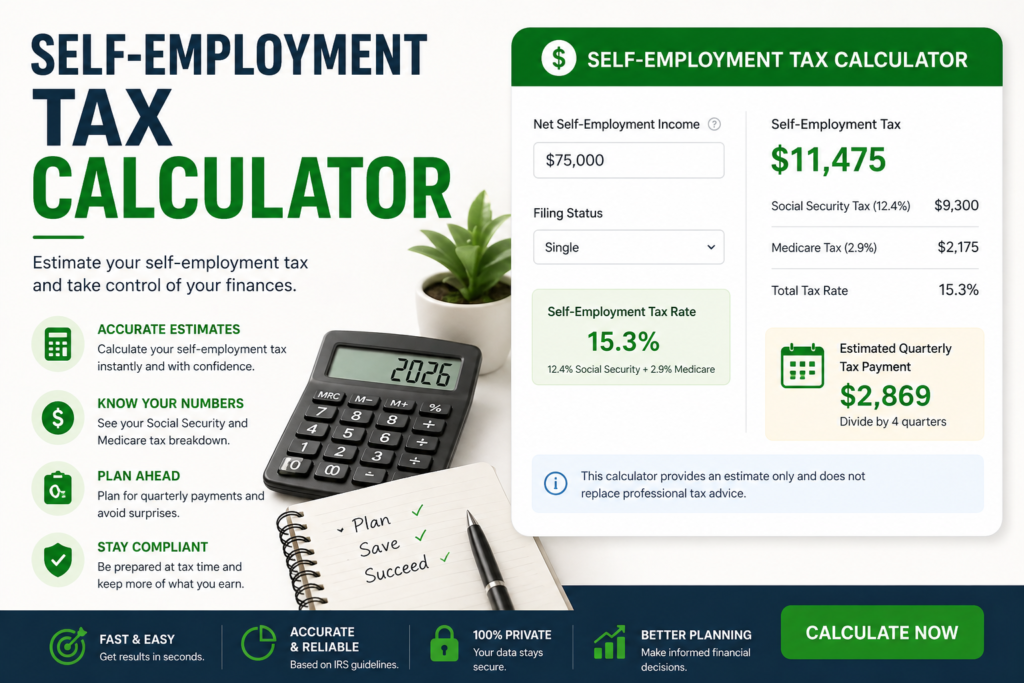
The self employment tax rate for 2026 is 15.3% in total. This breaks down into 12.4% for Social Security and 2.9% for Medicare. However, you do not pay this rate on your full income. Instead, the IRS applies it to 92.35% of your net profit — which already accounts for a small built-in adjustment. On top of SE tax, you also owe regular federal income tax and state income tax on your taxable income.
How the Self Employment Tax Calculator Works
Our free self employment tax calculator on the homepage handles every part of this calculation automatically. To start, enter your gross self-employment income for the year — this is your total earnings before any expenses. Next, subtract your business expenses such as mileage, equipment, and phone costs.The calculator then applies the 92.35% adjustment and calculates your SE tax at 15.3%. It also applies the 50% SE tax deduction on your return automatically.
After that, it adds your federal and state tax based on your filing status. Then it gives you a total estimated bill.It also splits that total into four quarterly payment amounts. That way you always know exactly what to send each quarter. Try it now on our free gig worker tax calculator page.
The Self Employment Tax Deduction You Should
One of the most helpful — and most overlooked — tax breaks for self-employed workers is the SE tax deduction. The IRS lets you deduct 50% of your SE tax from your gross income. So if your SE tax is $3,000, you deduct $1,500 before income tax kicks in.
This deduction exists because employed workers do not pay the employer half of payroll tax — so the IRS gives self-employed people a way to offset that extra cost. Our self employment tax calculator applies this deduction automatically, so your federal income tax estimate already reflects it.
How to Lower Your Self Employment Tax Bill
The best way to reduce your SE tax is to increase your business deductions. SE tax hits your net profit, not your gross income. Every dollar you deduct cuts both your SE tax and your income tax.
For gig workers, mileage is usually the biggest opportunity. At 72.5¢ per mile through June 30 and 76¢ after in 2026, tracking 10,000 business miles saves $7,000 in taxable income. That alone can reduce your SE tax by over $1,000. Furthermore, expenses like your phone bill, home office, equipment, subscriptions, and accounting fees all count as deductions if they are used for work. For the full IRS guidance on allowable deductions, visit the IRS Self-Employed Tax Center.
Who Has to Pay Self Employment Tax?
You owe self employment tax if your net self-employment income is $400 or more in a calendar year. This threshold is very low — it covers almost everyone who does any kind of freelance or gig work. It applies regardless of whether you also have a regular W-2 job. If you drive for DoorDash on weekends and earn $500, you owe SE tax on that $500 even if your day job already withholds regular income tax.
This is one of the most common surprises for new gig workers. Many assume their regular job’s withholding covers everything. In reality, SE tax is separate — you pay it on top of whatever your employer already withholds.
Quarterly Estimated Tax Payments for Self-Employed Workers
If you expect to owe $1,000 or more in total tax for the year, the IRS requires you to make quarterly estimated payments rather than paying everything in April. Missing these payments leads to an underpayment penalty — even if you pay the full amount when you file.
The 2026 quarterly due dates are April 15 for Q1, June 16 for Q2, September 15 for Q3, and January 15, 2027 for Q4. Our self employment tax calculator divides your total estimated bill into four equal payments so you always know what each one should be. You can verify official deadlines on the IRS estimated taxes page.
Calculate Your Self Employment Tax Right Now
The best time to check your SE tax is now — not in March when you are scrambling. Head to our free self employment tax calculator, enter your income and deductions, and get a full breakdown in under a minute. You will see your SE tax, your federal and state tax, your total bill, and your quarterly payment amounts all in one place.
For platform-specific guides, check out our DoorDash Tax Calculator, Uber Driver Tax Calculator, and Instacart Tax Calculator guides. Each one walks through the tax rules for that specific platform in plain language.