
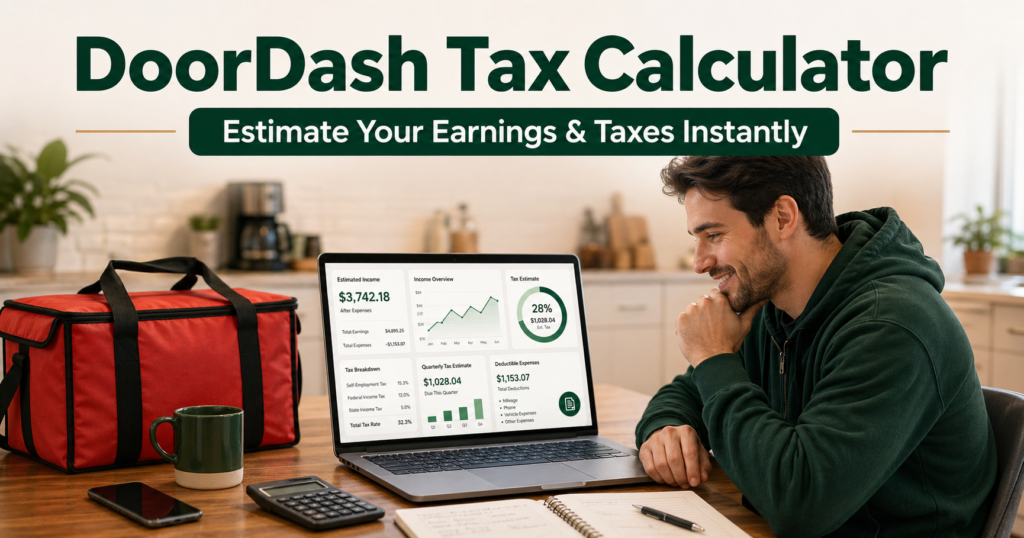
If you dash regularly, tax season can feel like a punch to the stomach. DoorDash takes out zero tax from your weekly pay. The full IRS bill is yours to figure out. Using a free DoorDash tax calculator before tax season tells you exactly what to set aside before each due date arrives.
Why DoorDash Drivers Pay More Tax Than Regular Employees
Most people who start dashing do not realize they are now classified as self-employed. That one change has a big impact on how much tax you owe. As a regular employee, your employer covers half of your Social Security and Medicare tax. As a Dasher, you cover all of it yourself — both halves. This is called self-employment tax, and it sits at 15.3% of your net profit on top of your regular income tax.
For example, if you earned $20,000 dashing in 2026 and had no deductions, your self-employment tax alone would be around $2,826. On top of that, you would owe federal income tax based on your total taxable income. That is why so many Dashers end up shocked at tax time — they only thought about income tax and forgot about the SE tax layer sitting underneath it.
How the DoorDash Tax Calculator Works
Our free DoorDash tax calculator on the homepage takes four key inputs and turns them into a full tax picture. First, you enter your total DoorDash earnings for the year — this is your gross income before any expenses. Second, you add your business miles driven. The calculator splits miles across the two 2026 IRS rates — 72.5¢ through June 30 and 76¢ from July 1. Third, add work expenses like your insulated bag, phone mount, or phone bill. Fourth, select your state and filing status.
From those four inputs, the calculator works out your net profit, your self-employment tax, your federal income tax, your state tax, and breaks everything into four quarterly payment amounts. In other words, you go from confused to fully informed in under a minute. You can try it right now on our free gig worker tax calculator homepage.
The Biggest Tax Deduction DoorDash Drivers Miss
Mileage is by far the most valuable write-off available to Dashers — and most drivers either do not track it at all or stop tracking the moment they complete a delivery. That is a costly mistake. According to the IRS, you can deduct business miles from the moment you are on an active dash to the moment you complete it. The 2026 rates are 72.5¢ per mile through June 30 and 76¢ from July 1, so a driver logging 10,000 miles evenly across the year deducts about $7,425. That saving is larger than it first appears: mileage reduces your net profit, which cuts both your income tax and your 15.3% self-employment tax. A Dasher in the 12% bracket saves roughly $891 in income tax plus about $1,136 in SE tax — around $2,027 in total
Moreover, you can also deduct the cost of your insulated delivery bags, car phone mounts, parking fees, tolls, and even a portion of your phone bill. Each of these cuts your taxable profit and therefore reduces both your income tax and your self-employment tax. For a full list of deductions available to gig workers, visit the IRS Self-Employed Tax Center.
When Do DoorDash Drivers Pay Quarterly Taxes?
As a self-employed Dasher, the IRS expects you to pay tax four times a year rather than once at the end. These are called quarterly estimated tax payments. Generally, if you expect to owe $1,000 or more for the full year, you are required to pay quarterly — and missing a deadline can lead to a penalty on top of what you already owe.
The 2026 quarterly due dates for DoorDash drivers are as follows. The first payment covers January through March and is due April 15. The second covers April and May and is due June 16. The third covers June through August and is due September 15. The fourth and final payment covers September through December and is due January 15, 2027. Our DoorDash tax calculator splits your total estimated bill into four equal payments so you always know exactly what to send and when.
How Much Should a DoorDash Driver Set Aside Each Week?
A good rule of thumb for most Dashers is to set aside 25–30% of every single payment that hits your bank account. However, the exact number depends on your state, your filing status, and how many deductions you track. A Dasher in Texas with no state income tax and strong mileage tracking might get away with 20%. On the other hand, a Dasher in California with high earnings and few write-offs could owe closer to 35%.
The safest approach is to run your numbers through a DoorDash tax calculator at least once every quarter so you can adjust your savings rate as your income changes. That way, April never feels like a crisis — it is just another payment you were already ready for.
Does DoorDash Send a 1099?
Yes — if you earned $600 or more from DoorDash in a calendar year, DoorDash will send you a 1099-NEC form by January 31 of the following year. This form shows your total earnings and is what you use to report your income to the IRS on Schedule C. Keep in mind that DoorDash reports your gross earnings — before any expenses — so it is up to you to track your deductions and report your actual net profit.
If you earned less than $600 in a year, DoorDash may not send a 1099. However, you are still legally required to report that income to the IRS. In short, all DoorDash income is taxable regardless of whether you receive a form.
Start With a Free Estimate Right Now
The best time to check your tax position is right now — not in March when the deadline is looming. Head over to our <a href=”/”>free gig worker tax calculator</a> and enter your DoorDash earnings, your miles, and your expenses. In less than a minute, you will have a clear picture of what you owe, how much to set aside, and exactly when each quarterly payment is due.
If you also drive for Uber or do other gig work, check out our Uber Driver Tax Calculator guide as well. And if you have any questions, our About Us page explains exactly who built this tool and why it will always be free.
More Guides for Gig Workers
Q: Does DoorDash take out taxes for Dashers?
A: No — DoorDash does not take out any taxes for Dashers. As an independent contractor, every dollar you earn from DoorDash lands in your bank account with zero federal tax, state tax, or self-employment tax withheld. The full tax responsibility falls entirely on you. That is why most Dashers should set aside 25-30% of every payment and use a free DoorDash tax calculator to know their exact bill before each quarterly due date.
Q: Do I have to pay taxes on DoorDash earnings?
A: Yes — every dollar you earn from DoorDash is taxable income. If you earn $600 or more DoorDash sends a 1099-NEC. Even below $600 the income must still be reported to the IRS on Schedule C.
Q: Do you have to pay taxes on DoorDash?
A: Absolutely — DoorDash income is self-employment income and is fully taxable. As a Dasher you owe self-employment tax at 15.3% plus federal and state income tax on top. DoorDash withholds nothing from your pay automatically.
Q: Do I have to file taxes for DoorDash if I made less than $600?
A: Yes — even without a 1099-NEC your DoorDash income is still taxable and must be reported on your annual tax return regardless of the amount.
Q: Do I get a W2 from DoorDash?
A: No — DoorDash sends a 1099-NEC not a W2 because you are an independent contractor not an employee.
Q: Are DoorDash earnings taxed differently than a regular job?
A: Yes — Dashers pay self-employment tax at 15.3% on top of regular income tax. Regular employees only pay 7.65% because their employer covers the other half. This is why most Dashers should set aside 25 to 30% of every payment.
Q: Do I have to report DoorDash on my taxes?
A: Yes — all DoorDash income must be reported on Schedule C of your federal tax return every year regardless of how much you earned.
thanks its very useful tool i found on internet.