Every Lyft driver needs a reliable Lyft driver tax calculator before tax season arrives. Unlike a regular job where your employer handles tax withholding automatically.

Lyft classifies all its drivers as independent contractors and pays every dollar straight into your bank account with nothing taken out. As a result, self-employment tax, federal income tax, and state income tax all land on you at once — and the bill can be significant if you have not planned ahead. This guide covers exactly what Lyft drivers owe, which deductions cut the bill, and how to use a free calculator to know your number before each quarterly due date.
Does Lyft Withhold Taxes from Driver Earnings?
No — Lyft does not withhold any taxes from driver earnings. Every trip payment, tip, and bonus goes directly into your account with zero federal or state tax deducted. At the end of the tax year, Lyft sends a 1099-K or 1099-NEC showing your total gross earnings — but that form is purely for reporting purposes. It does not mean Lyft paid any tax on your behalf.
This is fundamentally different from traditional employment. When you work as a regular employee, your employer quietly covers half of your Social Security and Medicare tax and withholds federal and state income tax from every paycheck. As a Lyft driver, none of that happens. Consequently, the full self-employment tax at 15.3% plus all income taxes are entirely your own responsibility. Understanding this from day one is the key to avoiding a surprise bill in April.
How Much Tax Do Lyft Drivers Pay?
The exact amount depends on your total earnings, your state, your filing status, and how many deductions you track. Generally speaking, most active Lyft drivers owe between 20 and 30 percent of their net profit in combined federal and state taxes.
Here is a real example to illustrate. A Lyft driver earning $38,000 per year in Florida — a no-income-tax state — who tracks 14,000 business miles and $600 in other expenses would calculate their taxes as follows. Their mileage deduction at 72.5¢ per mile through June 30 and 76¢ after comes to $9,800, bringing their net profit down to $27,600. Self-employment tax on that net profit is approximately $3,903. After applying the SE deduction and the $14,600 standard deduction for a single filer, their federal taxable income works out to roughly $10,748. At the 10% bracket their federal income tax is approximately $1,075. Their total federal tax bill therefore comes to around $4,978 — an effective rate of just 13.1% of gross income.
In contrast, a Lyft driver in California with the same income and no mileage tracking could face a bill of $10,000 or more once state income tax is added. This is exactly why deduction tracking and using a free free tax calculator for rideshare drivers makes such a significant difference.
Lyft Driver Tax Calculator — Top Deductions That Lower Your Bill
Deductions are the most powerful tool available to Lyft drivers for reducing their tax bill. Every dollar deducted reduces net profit — and since self-employment tax is calculated on net profit, every deduction cuts two taxes at the same time.
Mileage is by far the largest deduction for rideshare drivers. At the 2026 IRS mileage rate of 72.5¢ per mile through June 30 and 76¢ after, a Lyft driver with 15,000 annual business miles earns a $10,500 deduction. Importantly, your business miles begin the moment you open the Lyft driver app — not when you accept a ride. Dead miles between rides, driving to a busy pickup zone, and returning home after your last ride of the day all count as deductible business miles. For this reason, using a mileage tracking app like Stride or MileIQ from day one is one of the highest-return habits a rideshare driver can build.
Beyond mileage, several other deductions are available to Lyft drivers. A portion of your monthly phone bill is deductible since the Lyft app runs on your phone throughout every shift. Car accessories like phone mounts, chargers, and dash cams purchased for work are also fully deductible. Additionally, parking fees and tolls paid during work trips can be written off dollar for dollar. Furthermore, the IRS lets you deduct 50% of your total self-employment tax from your gross income before calculating income tax — a deduction that most drivers miss entirely. For the complete list of allowable deductions, visit the IRS Self-Employed Tax Center.
Lyft vs Uber Tax Calculator — Is There a Difference?
The underlying tax calculation is identical for Lyft and Uber drivers since both platforms classify drivers as independent contractors under the same IRS rules. Both owe self-employment tax at 15.3%, both use the same federal income tax brackets, and both follow the same quarterly payment system.
The practical differences come from driving patterns rather than tax rules. Lyft drivers who work primarily in urban areas often accumulate more miles per shift than suburban drivers — which directly affects the size of their mileage deduction. Similarly, drivers who work across both Lyft and Uber simultaneously should add their total combined income and mileage into the calculator since the IRS treats all rideshare income as a single block of self-employment income on Schedule C.
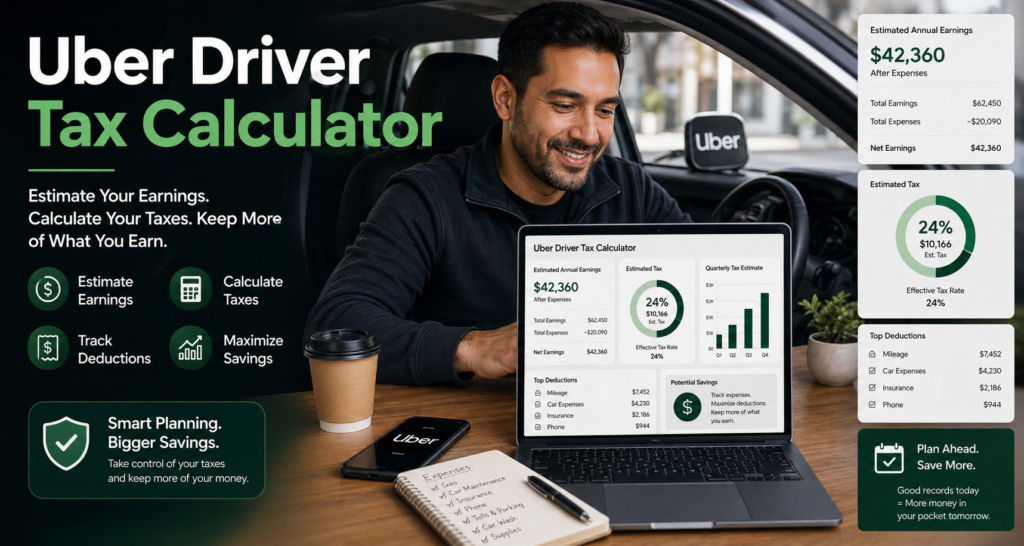
Our free calculator covers both Lyft and Uber drivers equally. Simply select the Uber/Lyft platform button, enter your combined rideshare income and miles, choose your state, and get your full 2026 tax breakdown. For a detailed Uber-specific guide, read our Uber driver tax calculator page.
How to Pay Lyft Driver Taxes — Quarterly Payment Guide
Because Lyft withholds nothing from driver earnings, the IRS requires most active drivers to pay estimated taxes four times a year. As a general rule, if you expect to owe $1,000 or more for the full year, quarterly payments are required. Most full-time and part-time Lyft drivers cross this threshold easily.
The 2026 quarterly due dates for Lyft drivers are as follows. Q1 covers January through March and is due April 15, 2026. Q2 covers April and May only — note that Q2 is shorter than the other quarters — and is due June 16, 2026. Q3 covers June through August and is due September 15, 2026. Q4 covers September through December and is due January 15, 2027.
To make a quarterly payment, go to pay.irs.gov — the official free IRS payment portal. Select Estimated Tax as the payment type, choose your quarter and tax year, enter your bank routing number and account number, and confirm. The payment processes immediately and is completely free. Save your confirmation number as proof of payment. For a full step-by-step guide on quarterly payments, read our article on how to pay quarterly taxes as a gig worker.
How Much Should Lyft Drivers Set Aside for Taxes?
A reliable starting point for most Lyft drivers is to set aside 25 to 30% of every payment received. However, your exact rate depends on several factors including your state, your filing status, and how consistently you track deductions.
Drivers in no-income-tax states like Florida, Texas, Nevada, or Washington who track mileage consistently can often manage with 20 to 22% since their total bill is lower. On the other hand, drivers in California, New York, or Oregon — where state income tax can reach 9 to 11% — should set aside closer to 30 to 33% to be safe.
The most reliable approach is to run your numbers through a free Lyft driver tax calculator at the start of each quarter and adjust your savings rate accordingly. That way your quarterly payment is never a surprise — it is simply the amount that has been sitting in your dedicated savings account waiting to be sent to the IRS.
Use Our Free Lyft Driver Tax Calculator Right Now
The fastest way to know your exact tax position as a Lyft driver is to use our free calculator on the homepage. Enter your total Lyft earnings for the year, your annual business miles, any other work expenses, your state, and your filing status. In under 60 seconds you will see your full self-employment tax, federal and state income tax, total bill, and exact quarterly payment amounts for all four 2026 IRS due dates.
Try the free Lyft driver tax calculator now — no sign-up required and completely free. For other rideshare and gig worker guides, also read our Uber driver tax calculator, our DoorDash tax calculator, and our self-employment tax calculator guides.
Frequently Asked Questions — Lyft Driver Taxes 2026
Does Lyft send a 1099 to drivers?
Yes — Lyft sends a 1099-K if you earned $5,000 or more through the platform, or a 1099-NEC for other payments. Both forms arrive by January 31 and show your gross earnings before any deductions.
Can Lyft drivers deduct car expenses?
Yes — Lyft drivers can choose between the standard mileage deduction at 72.5¢ per mile through June 30 and 76¢ after or the actual expense method where you deduct a percentage of real car costs. Most drivers benefit more from the mileage method since it is simpler and typically higher in value.
Do Lyft drivers pay taxes on tips?
Yes — all tips received through the Lyft app are taxable income and must be included in your gross earnings when calculating your tax bill.
What happens if a Lyft driver misses a quarterly payment?
Missing a quarterly deadline results in an IRS underpayment penalty calculated on the amount that was due. The penalty applies per quarter — so missing multiple quarters compounds the total penalty. Pay on time at pay.irs.gov to avoid all penalties.
Is there a free Lyft driver tax calculator for all 50 states?
Yes — our free tool at FreelancerTaxCalc.com covers all 50 US states plus Washington DC. Simply select your state from the dropdown and the correct state income tax rate is applied automatically to your estimate.