Do DoorDash Drivers Have to Pay Taxes? Everything Dashers Need to Know in 2026
Do DoorDash drivers have to pay taxes? Yes — and the bill is often larger than new Dashers expect. DoorDash does not withhold a single dollar of tax from your weekly earnings. As a result, every dollar of self-employment tax, federal income tax, and state income tax is your responsibility to calculate and pay on your own. This guide covers exactly what Dashers owe, when they have to pay, and how to calculate the right amount so tax season never feels like a crisis.
Do Uber Drivers and DoorDash Drivers Pay Taxes the Same Way?
Yes — both Uber drivers and DoorDash drivers are classified as independent contractors and follow the same tax rules. Neither platform withholds any tax from driver earnings. Both require drivers to pay self-employment tax at 15.3%, federal income tax based on their bracket, and state income tax where applicable. Furthermore, both platforms send a 1099-NEC at the end of the year rather than a W-2, meaning drivers report their income on Schedule C rather than as regular employment income.
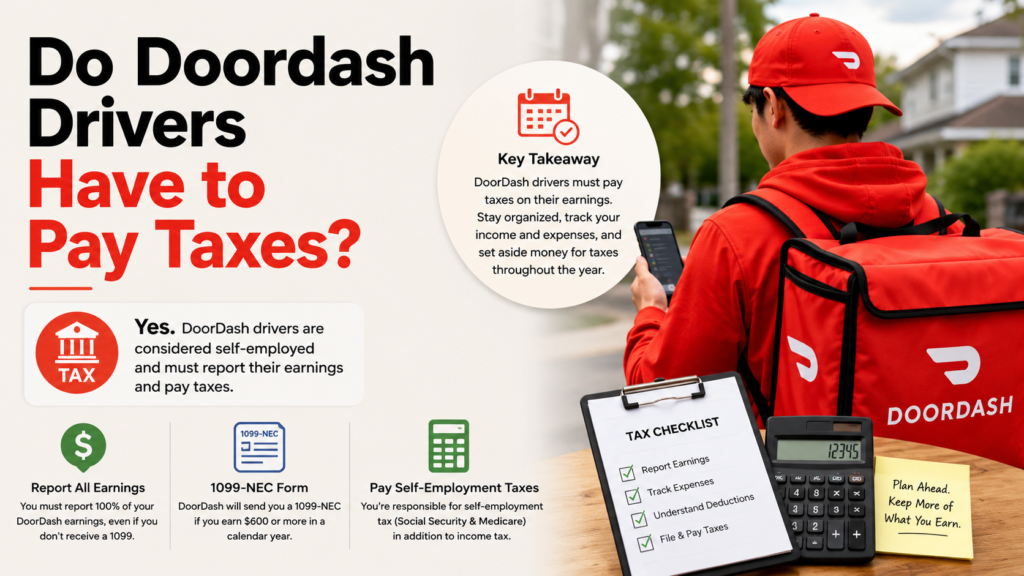
The key difference between gig work and regular employment is that traditional employees split payroll tax with their employer — each side paying 7.65%. As a DoorDash or Uber driver, you pay the full 15.3% yourself. Consequently, gig workers often owe more total tax than they expected when they first started driving.
Does DoorDash Take Out Taxes for Dashers?
No — DoorDash does not take out taxes for Dashers. This is one of the most important things every new Dasher needs to understand before their first delivery. When DoorDash pays you, 100% of your earnings go directly into your bank account with nothing withheld for the IRS.
This is fundamentally different from a regular job. At a traditional employer, federal income tax, state income tax, and half of your Social Security and Medicare tax are all removed from every paycheck before you see the money. DoorDash does none of this. Instead, the platform treats you as a self-employed business owner and leaves all tax management entirely to you.
Because DoorDash takes out no taxes, many Dashers spend their full earnings throughout the year and are left scrambling in April. The solution is simple — set aside 25 to 30% of every DoorDash payment immediately and move it to a separate savings account. That money stays untouched until each quarterly tax due date arrives.
How Much Tax Do DoorDash Drivers Pay?
The exact amount depends on your total earnings, your state, your filing status, and how many deductions you track. Generally speaking, most active Dashers owe between 20 and 30% of their net profit in combined federal and state taxes.
Here is a real example. A Dasher earning $32,000 per year in Texas — a no-income-tax state — who tracks 9,000 business miles and $400 in other expenses would calculate their taxes as follows. Their mileage deduction is $6,300 and their total deductions come to $6,700, leaving a net profit of $25,300. Self-employment tax on that net profit is approximately $3,578. After applying the SE deduction and standard deduction, their federal income tax comes to roughly $1,100. Their total federal tax bill is therefore around $4,678 — an effective rate of about 14.6% of gross income.
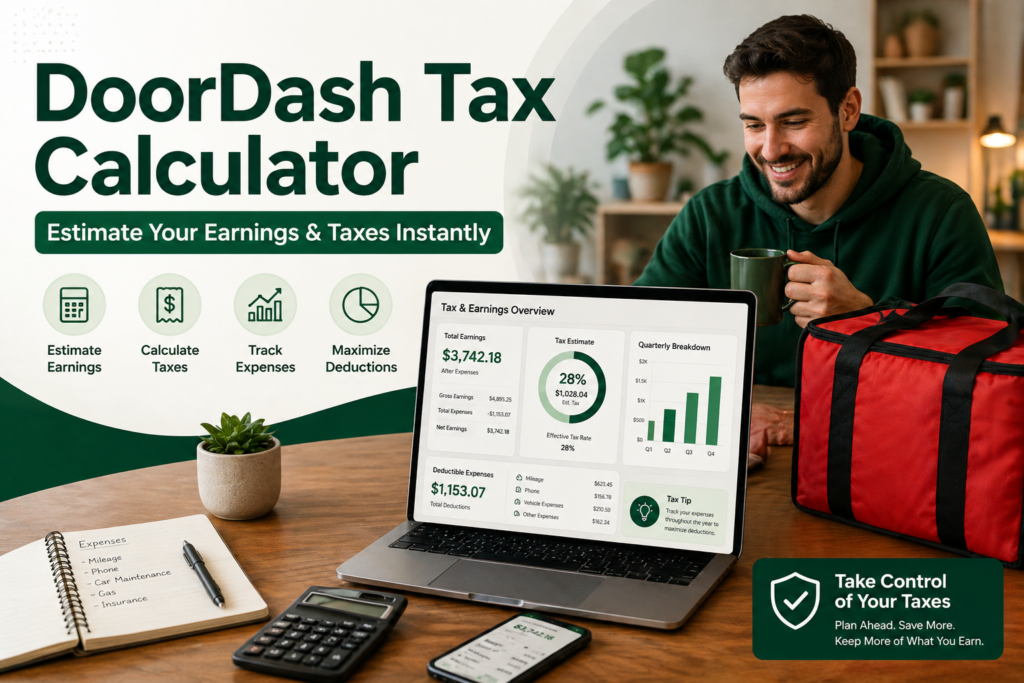
In contrast, a Dasher in California earning the same amount with no mileage tracking would owe significantly more — potentially $8,000 to $9,000 once state income tax is added. This illustrates exactly why deduction tracking matters so much. To calculate your own number instantly, use our free DoorDash tax calculator on the homepage.
How Do DoorDash Drivers Calculate Their Taxes?
Calculating DoorDash taxes accurately involves four steps. Working through each one gives you a reliable number you can plan around throughout the year.
The first step is to add up your total gross DoorDash income — every dollar from base pay, tips, and promotions for the year.
The second step is to subtract your business deductions. Mileage is the largest for most Dashers. At 72.5¢ per mile through June 30 and 76¢ after in 2026, every business mile reduces your taxable profit directly. Beyond mileage, subtract your phone bill business portion, hot bags, car accessories, and parking fees paid during deliveries.
The third step is to calculate self-employment tax on 92.35% of your net profit at 15.3%. The 92.35% adjustment is built into the IRS formula and accounts for the deductible portion of SE tax.
The fourth step is to calculate federal income tax on your remaining taxable income after the SE deduction and standard deduction are applied. Add state income tax on top based on your state rate.
The fastest way to complete all four steps is to use a free DoorDash tax calculator that handles every step automatically. Our tool at FreelancerTaxCalc.com covers all 50 states and gives your full breakdown in under 60 seconds.
How Do DoorDash Drivers Pay Their Taxes?
DoorDash drivers pay their taxes in two ways — quarterly estimated payments throughout the year and an annual return in April.
For quarterly payments, go to pay.irs.gov — the official free IRS Direct Pay portal. Select Estimated Tax as the payment reason, choose your tax year and quarter, enter your bank account details, and confirm. The payment is free and processes immediately. Save your confirmation number as proof.
The 2026 quarterly due dates for DoorDash drivers are April 15 for Q1, June 16 for Q2, September 15 for Q3, and January 15, 2027 for Q4. Missing any of these dates results in an underpayment penalty on top of what you already owe.
For the annual return, file Schedule C with your Form 1040 by April 15. Schedule C is where you report your gross DoorDash income, subtract all your deductions, and calculate your net profit. Your SE tax is then calculated on Schedule SE. Any remaining tax owed after your quarterly payments is due with your annual return. For a full step-by-step guide read our post on how to pay quarterly taxes as a gig worker.
How Often Do You Pay Taxes for DoorDash?
Most active Dashers pay taxes four times a year through the quarterly estimated tax system. As a general rule, if you expect to owe $1,000 or more for the full year — which most full-time and part-time Dashers do — the IRS requires quarterly payments rather than a single annual payment.
If your DoorDash income is minimal — say under $5,000 per year as a very occasional side earner — your total tax bill may fall below $1,000 and quarterly payments may not be required. In that case, paying the full amount with your annual return by April 15 is sufficient. However, if you are dashing regularly and earning $15,000 or more per year, quarterly payments are almost certainly required. Check the IRS estimated taxes page for the official threshold guidance.
Calculate Uber Tax and DoorDash Tax — Are the Calculators Different?
The underlying tax calculation is identical for Uber and DoorDash drivers since both platforms classify drivers as independent contractors subject to the same IRS rules. The differences in a platform-specific calculator come from the types of deductions each platform allows rather than the tax formula itself.
For Uber drivers, mileage tracking is especially important since rideshare drivers often cover more miles per shift than delivery drivers. For DoorDash drivers, hot bags and food delivery equipment are additional deductions that rideshare drivers typically do not claim. Beyond those differences, both use the same self-employment tax rate, the same federal brackets, and the same quarterly payment system.
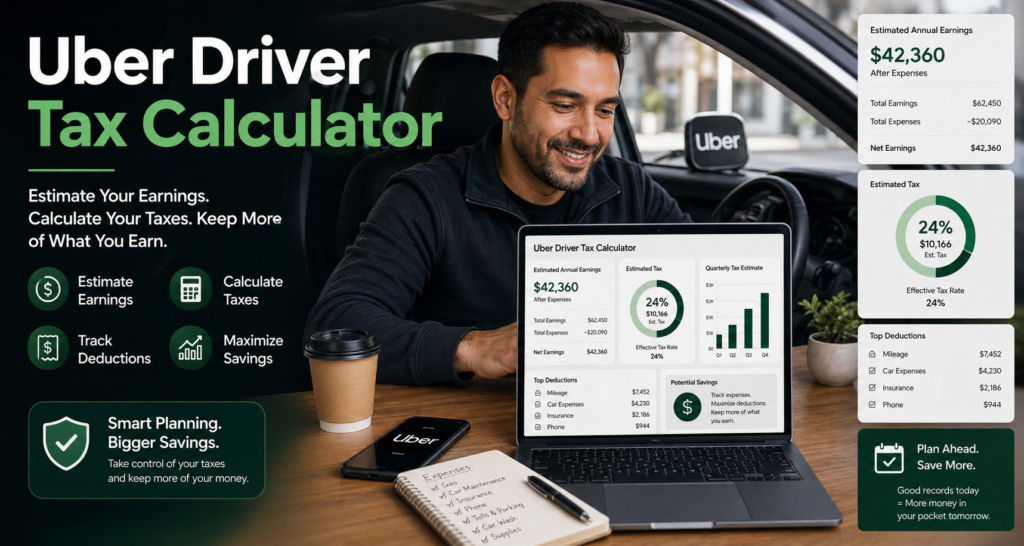
Our free calculator covers both Uber and DoorDash drivers. Simply select your platform at the top, enter your income and miles, and get your full 2026 tax estimate. For a platform-specific guide, read our full Uber driver tax calculator guide or our self-employment tax calculator guide.
Frequently Asked Questions — DoorDash Driver Taxes 2026
Do Uber drivers pay tax the same way as DoorDash drivers?
Yes — both platforms classify drivers as independent contractors. Both owe self-employment tax, federal income tax, and state income tax. Neither platform withholds anything from driver pay.
Does DoorDash take out taxes for Dashers automatically?
No. DoorDash pays gross earnings with zero tax withheld. All tax calculation and payment is the Dasher’s own responsibility.
Do DoorDash drivers have to pay taxes if they only dash occasionally?
Yes — all DoorDash income is taxable regardless of how much you earn or how often you dash. If you earn $600 or more DoorDash sends a 1099-NEC. Even below $600 the income must still be reported to the IRS.
How often does DoorDash pay — and does payment frequency affect taxes?
DoorDash pays weekly by default or daily with Fast Pay for a small fee. Payment frequency does not affect your tax obligation — your total annual earnings are what matters, not how often you receive them.
What is the easiest way to calculate taxes for DoorDash?
The fastest way is to use a free DoorDash tax calculator that handles self-employment tax, federal and state income tax, mileage deductions, and quarterly payments all in one place. Our free tool at FreelancerTaxCalc.com takes under 60 seconds and covers all 50 states.